
When people hear UFO, they think of Aliens.
A UFO is, however, quite literally something observed in the sky that hasn't been identified. The newer term, UAP (Unidentified Anomalous Phenomena) doesn't help the problem: Something happened. Someone observed it. We don't know what it was.
I explored that distinction with Ben Moss, an independent UFO/UAP researcher, investigator and author. Ben joined the Mutual UFO Network (MUFON) in the 1990s, becoming a chief investigator. He has appeared as a UFO researcher on Netflix, the History Channel, Discovery Channel and Travel Channel. He and Tony Angiola spent five years investigating a case for which he wrote, Not of This World: The 1964 Socorro UFO Landing with Humanoids.
Our conversation seemed to tangent beyond that case. We talked about Roswell, government secrecy, military technology, UFO videos, abductions, artificial intelligence, other dimensions and what an advanced civilization might look like.
More than about whether aliens exist, the conversation was a chance to examine how we investigate something when some of the evidence is no longer available.
The Socorro Incident
This case occurred near Socorro, New Mexico, in April 1964. According to the account Ben reconstructed, police officer Lonnie Zamora wasn't looking for UFOs. He was doing his job. Zamora was pursuing a speeding vehicle when he saw a blue flame and thought an airplane might be crashing somewhere in the desert.
He went to investigate.
Getting there wasn't easy. Zamora needed three attempts to get his police vehicle up a hill.
When he finally crested it, he thought he was looking at an overturned vehicle.
Until he got closer.
According to Zamora's account, it wasn't a car. It was an egg-shaped object resting on four landing supports.
Near it were two small figures, about four feet tall.
They were looking underneath the object, perhaps because the craft was experiencing some kind of problem. (That last part is Ben's interpretation.)
The reported object, its shape, landing supports, and two small figures are central parts of the account Ben investigated.
There's a detail that makes Socorro harder to reduce to “an unidentified aircraft.” If Zamora had reported only an egg-shaped object flying through the air, there would be many possible explanations. Today we might ask whether it could be a drone.
Zamora didn't report only a craft. He reported two small figures beside it, roughly four feet tall, which according to the account then entered the object before it departed.
We can't explain the object while ignoring its reported occupants. If it was some kind of experimental aircraft, who were the figures? If it was remotely operated, why were there figures that entered it? If it was a hoax, how were the craft, figures, flight, physical traces, and other observations produced?
Even today, I'm not aware of a drone explanation that would make an object carrying two roughly four-foot-tall occupants unremarkable. That doesn't make the figures extraterrestrial. They could have been human, something Zamora misperceived, or something else. They are part of the observation any explanation has to account for.
Zamora May Not Have Been the Only Person Who Saw Something
Ben described a family (a husband, wife and three children) who had been driving in the area and stopped at Opal Grinder's gas station before Zamora's encounter. According to Ben, the family told Grinder that a strange craft had nearly hit their car.
Grinder suggested it was a helicopter.
The family replied that, if it was a helicopter, it was a strange one. They described it as egg-shaped, and said they had seen a police officer going after it, so they assumed the situation was being handled.
Ben interprets this as possible evidence that the object was having trouble navigating.
There was a geographical complication.
Ben says the place where the object landed was in a depression. Unless someone was in the right position, the landing site couldn't easily have been seen from surrounding locations. Ben says three people called from Albuquerque reporting a blue flame traveling toward Socorro.
Then It Left
According to the account, the two figures went back into the object, and the blue flame appeared again.
Zamora was about 35 feet away.
If the blue flame had been conventional rocket exhaust, Zamora should have experienced enormous heat associated with the exhaust. In Ben's words, he would have been “cooked.”
Zamora wasn't.
Ben concludes that the blue flame wasn't functioning as ordinary rocket propellant. That's worth investigating.
Ben says that after the figures entered, the object rose, the blue flame disappeared, it became silent, hovered briefly, then accelerated away toward an area known as the perlite mill, reaching what Ben estimates may have been close to supersonic speed.
Then it was gone.
If Zamora's account is accurate, the most valuable piece of evidence in the case just flew away.
Something Was Left Behind
According to the investigation, the craft left physical evidence at the site.
Ben says the object had rested on four landing supports. The impressions in the ground were reportedly wedge-shaped.
One proposed explanation was a lunar-landing vehicle. Ben points out that the lunar lander's landing gear was round, while the impressions attributed to the Socorro object were wedge-shaped. He says Dr. J. Allen Hynek, who investigated UFO reports for the Air Force's Project Blue Book, examined the site, and estimated from the impressions that whatever made them weighed approximately nine tons.
The Witness Matters
Zamora wasn't an anonymous person telling a strange story decades after it happened. His professional circumstances are relevant when evaluating his testimony. He was a police officer reporting something that happened while he was working. That doesn't make him infallible. Police officers can misperceive things and make mistakes. They can lie.
According to Ben, Zamora wasn't interested in UFOs and had no reason to seek publicity from it. Ben says the experience changed his life, and not for the better.
Ben and Tony spoke with Zamora's family and friends during their investigation.
Zamora was a devout Catholic. On the night of the encounter he spent three or four hours with his priest trying to make sense of what had happened. The priest gave Zamora two choices:
Tell the truth or stop talking about it.
Zamora chose to keep telling the story, and never changed or embellished it for the rest of his life.
Ben says Zamora initially referred to the figures as small boys in white coveralls and later in life called them “creatures.” Ben interprets that change as suggesting Zamora may have gotten a better look at them than he initially wanted to acknowledge. That's Ben's interpretation. We can't know what was going through Zamora's mind. Television stations and others wanted interviews and offered opportunities, including travel. Zamora didn't pursue them.
How Ben Became Involved
Ben didn't begin investigating Socorro in 1964. He heard filmmaker James Fox discuss Socorro at a conference. He remembered seeing television footage, supposedly shot by someone who had driven through the area with a family, and filmed the landing location shortly after the event. Ben told Fox he would find the footage.
That search grew. Ben says the effort resulted in two covers of the MUFON Journal devoted to the search for the lost Socorro footage.
As he dug , he kept finding more material. The question changed. Instead of merely finding the footage, Ben and Tony began testing explanations for what Zamora had reported.
Their investigation lasted five years.
They traveled to Socorro three times.
They spoke with Zamora's family and friends.
They investigated people associated with a proposed student hoax.
They investigated the lunar-lander explanation.
They studied historical records and Project Blue Book material.
Was It a Student Hoax?
One explanation proposed was that students had staged the entire thing. Ben went looking for them. He located the students who had been named in connection with the alleged hoax, and concluded that the person who had implicated them had created a story and later tried to cover it up.
The students were incredulous that they had been blamed. They told Ben they had been taking exams, and pointed to the practical difficulty of staging something at the location: rocks, scorpions, difficult terrain and poor vehicle access.
Ben and Tony experienced the access problem themselves. Ben says they “beat our rental car to death” trying to reach the site. More importantly, Ben argues that a student-hoax explanation has to account for the entire sequence, not just Zamora's observation at the landing site.
It would need to account for Zamora seeing the blue flame, while pursuing a speeder.
It would need to account for the reported family encounter, before Zamora reached the site.
It would need to account for the calls reporting a blue flame moving toward Socorro.
It would need to account for the object, figures, and physical impressions.
Ben concluded that the student-hoax explanation didn't do all that.
Was It a Lunar Lander?
A proposed explanation was that Zamora had encountered a test of a lunar-landing vehicle. Ben is dismissive of this explanation. What's useful is why he dismisses it.
According to Ben, the lunar lander was being tested at Holloman, roughly 30 miles away. He questions why a top-secret test vehicle would be flown in a public desert, away from the designated test facility.
He points to the flight history - that the lunar-landing test vehicle had only one atmospheric test flight, and that the flight nearly killed its pilot, who had to eject only about 200 feet before the vehicle hit the ground. That was the only atmospheric flight before the lunar mission.
Then there is the landing gear. The lunar lander had round landing gear. The impressions attributed to the Socorro object were wedge-shaped. Hynek reportedly estimated that the impressions were produced by something weighing approximately nine tons.
Ben concluded the lunar-lander explanation didn't fit.
Ray Stanford and the Earlier Investigation
Ben and Tony met Ray Stanford, who had investigated Socorro closer to the time of the event and wrote an early book about the case. According to Ben, Stanford was at Socorro approximately two weeks after the incident, with Hynek, and interviewed Zamora himself.
That's important, as Ben's investigation occurred decades later. The closer an investigation occurs to an event, the greater the opportunity to examine physical conditions, interview witnesses while memories are fresh, and preserve contemporaneous records.
Ben wasn't only relying on his reconstruction. Part of his work involved examining what earlier investigators had documented.
The Project Blue Book Files
One of the strangest parts of Ben's investigation involved historical Project Blue Book records. Ben says someone discovered a box of Blue Book files for sale on Craigslist after a former Project Blue Book officer had moved and apparently left the box behind.
The box contained substantial material related to Socorro.It contained a photograph that had once been classified top secret and later declassified, with the classification information indicated on the back. The internal records show the investigators themselves were baffled.
Ben described Captain Holder, whom he identifies as an upper-range commander at White Sands involved with the case. According to Ben, Holder recalled that years afterward, the Joint Chiefs of Staff were still asking whether the incident could be explained.
Ben says Holder's answer was, “No known black project accounted for it, and we didn't build egg-shaped craft like that.”
If Ben's characterization of those records is correct, it establishes that government investigators couldn't identify the object as a known project.
It doesn't establish Government investigators determined it was extraterrestrial. Those are different claims.
Ben's Conclusion
Ben and Tony concluded that Zamora encountered something “not of this world."
Ben describes his investigative approach as beginning without deciding that the object was extraterrestrial. He says they tried to find a reasonable conventional explanation and eliminated explanations that didn't fit the evidence. Eventually, he says, they “ran out of reasonable explanations” and had to confront the possibility that Zamora saw what he said he saw.
There's A Problem: The Craft Is Gone
Suppose Zamora's account is accurate:
A craft landed.
It left impressions in the ground.
He saw it at close range.
He saw two four-foot-tall figures enter it.
It produced a blue flame.
It departed.
What can a later investigator do that would prove what the object was?
They can examine Zamora's testimony, assess his credibility, and talk to family and friends. They can investigate the family who saw an unusual object, examine reports of people seeing a blue flame. They can study photographs and examine landing impressions, and compare the impressions with known aircraft. They can investigate student-hoax claims and experimental aircraft. examine military records, and ask whether radar recorded anything..
They can't examine the thing itself. It flew away.
That means even an excellent investigation may never be able to answer the question we most want answered: What was it?
“I Have to See It Myself”
This exposes something interesting about skepticism.
Suppose someone says, I won't believe a craft landed there unless I see the craft myself.
That's a legitimate personal standard. If the craft did land and then flew away, that standard is impossible to satisfy.
That doesn't mean we should believe Zamora because he was a police officer.
It doesn't mean an unexplained Blue Book case proves aliens.
We shouldn't go from thinking, "the evidence doesn't tell me what the object was" to concluding, "there isn't evidence that something happened." Sometimes a disagreement is about how much evidence we require before we're willing to believe something outside our experience.
What Does “Unidentified” Mean?
Seeing a UFO doesn't mean seeing an alien spacecraft. Meteorological phenomena can fool us. Drones can look strange. Aircraft can be misidentified. Lights in the sky can have mundane explanations.
Socorro wasn't a report of a strange light or unidentified object. Zamora reported a structured object on the ground, resting on four supports, with two four-foot-tall figures beside it that entered it before it departed.
While “drone,” “aircraft,” or “meteorological phenomenon” may be reasonable possibilities for an unidentified object, an explanation for Socorro has to account for the complete reported event—not only provide something that could explain an object in the sky.
Ben Is Skeptical Too
It's also easy to be think of someone who believes in UFOs as someone who will believe anything. Ben isn't one of those. He told me there's an enormous amount of bad UFO material online. When he investigates modern cases, one of his first questions is whether the witness is lying, whether something was fabricated or whether an image is computer-generated.
He says he can recognize fake UFO videos and described how metadata once provided useful information about the camera and circumstances surrounding an image, while modern manipulation makes metadata less reliable.
His advice was: Do your own homework.
I would add: And try to disprove the explanation you currently favor. If you believe an object was extraterrestrial, look for the terrestrial explanation that would prove you wrong. If you believe extraterrestrial visitation is impossible, ask what evidence would change your mind.
If the answer is: Nothing, unless I personally see one, acknowledge that. At that point your position isn't about what the evidence is in the case. It's about your threshold for believing an extraordinary event.
Firsthand Experience Changes People
Ben said some of the strongest skeptics change dramatically after having their own sighting.
Beforehand:
There's no such thing.
Afterward:
Let me tell you what I saw.
And sometimes:
“Until it happens to you, you have no idea what's going on.”
The Truth May Be Out There. Certainty May Not.
Ben believes the Socorro object was not of this world. I think the intellectually responsible response is to reduce the case to:
Someone told a strange UFO story in 1964.
There's more to investigate than that.
The question isn't:
Do I believe this happened?
It's: What evidence do I require before believing something I've never personally experienced, and is that evidence possible to obtain ?
If my answer is:
“I'd have to see it myself,”
that's worth recognizing. Then I may not be saying the evidence shows Zamora was wrong. I may be saying, No evidence this event could have left behind would be enough for me to believe it.
The truth may be out there.
Sometimes the accurate conclusion is:
Something happened. We have evidence to investigate. We don't know exactly what it was.
Listen or Watch
Apple Podcasts • YouTube • Spotify
What Could Have Happened?
A Follow-Up Thinking Exercise
Now that we've examined the case, given the evidence, what explanations remain possible?
We shouldn't consider one thing at a time or ask for example, “What could the egg-shaped object have been?” Rather, in this case we need to consider evidence as a complete profile :
What explanation can account for the object, the figures associated with it, the landing traces, the blue flame, the departure behavior, Zamora's testimony, and surrounding observations?
1. Zamora fabricated the event
This is logically possible.
There may have been no craft and no occupants, Zamora invented some or all of the story, and the physical evidence had another cause or was manufactured.
The difficulty with this explanation is it has to account for the things the article presents as supporting his sincerity: he was an on-duty police officer, wasn't seeking UFO publicity, reportedly experienced personal/reputational consequences, stuck to his original story, and according to Ben, didn't capitalize on media opportunities. It has to deal with the reported physical impressions and other observations surrounding the event.
→ Possible. It requires explaining more than, “Zamora lied.”
2. Someone staged a hoax that fooled Zamora
This is different from Zamora fabricating it. Zamora could have truthfully reported what he saw, and what he encountered was constructed by others. That could account for the craft and figures simultaneously: the figures were those participating in the hoax, and the object was a constructed prop/device.
The hoax is technically demanding, as it has to account for an object capable of departing as Zamora described, the blue flame, landing impressions, figures, and the difficulty of accessing the location.
Ben investigated the proposed student-hoax explanation.
→ He concluded it failed to account for the entire sequence.
3. Zamora encountered a terrestrial experimental craft - with human occupants
This is interesting. Suppose the object was real, Zamora accurately described it, and the approximately four-foot figures were short-statured human occupants.
We can explain craft + occupants + landing + departure, without invoking extraterrestrials.
This explanation has constraints.
The craft would need to accommodate two occupants, use technology capable of the flight behavior, account for the blue flame without injuring Zamora at the reported distance, and produce the physical impressions.
It has to explain why subsequent investigators apparently couldn't connect it to a known program. According to Ben's characterization of the historical records, investigators were unable to identify it as a known black project.
That's not proof it wasn't secret technology. A sufficiently secret program might not have been disclosed to the investigators.
According to Ben Moss, “There has never been an aviation program in the US that requires 'small' pilots.”
4. It was lunar-landing technology
This is a subset of #3. It deserves separate treatment, as it's an explanation some have proposed, and Ben investigated. It would provide: a terrestrial craft + landing gear + human activity.
According to Ben, characteristics don't fit. The testing location, flight history, round landing gear versus reportedly wedge-shaped impressions, and other characteristics of the event.
→ Based only on the evidence presented, this explanation appears weaker than the possibility of an unknown experimental craft.
5. Zamora saw something real, and mis-perceived parts of it
Maybe there was a real aircraft or experimental vehicle:
- the “figures” weren't occupants
- their height was misjudged
- they didn't enter the object
- the object's shape was misperceived
- its distance or speed was misjudged
- the blue flame wasn't what it appeared to be
This can explain a lot. There's a cost to it.
The more reported details we have to declare erroneous, the less we're explaining Zamora's account. We shouldn't explain the easy part, and discard everything our explanation can't accommodate. This explanation depends on determining which observations we have independent reasons to distrust, rather than deciding they're wrong because they're difficult to explain.
6. Several unrelated things happened - and Zamora connected them
A possibility is that there was no single phenomenon responsible for everything. Perhaps:
- something produced the blue flame;
- something else produced the ground impressions;
- the figures were people;
- the object was something mundane;
- surrounding witnesses saw unrelated phenomena.
And Zamora sincerely assembled them into one event.
It's coincidence-dependent. The more pieces we separate, the more independent events have to occur in the same place and time and appear related.
7. A real non-human craft, with non-human occupants
This is closest to Ben and Tony's conclusion, that the object was, “not of this world.” Once we allow a nonhuman-craft hypothesis into the set of possibilities, it accounts for several otherwise difficult observations together rather than separately:
- unfamiliar craft
- unusually small occupants
- unusual propulsion/flight behavior
- no identified terrestrial program
- physical landing traces
That's one reason the figures matter so much. They don't prove extraterrestrial origin. They make the hypothesis different from saying, “We don't know what the thing in the sky was, therefore it was a UFO carrying aliens.”
There is between something being nonhuman and extraterrestrial. Establishing something as nonhuman wouldn't automatically establish it as extraterrestrial.. Maybe miniature Big Foot creatures were flying the craft.
Where Does That Leave Us?
After considering the possibilities, There is a modest conclusion the available evidence supports:
Something appears to have happened at Socorro that the explanations examined don't account for.
That doesn't mean, Zamora saw extraterrestrials.
It doesn't mean, Zamora must have been mistaken.
There's evidence worth taking seriously that Zamora experienced a real event. The surviving evidence is insufficient to establish what produced it.
Don't Rank the Explanations by How Strange They Sound
There's another way we can approach the problem. Instead of ranking explanations from ordinary → extraordinary, rank them by: How much of the reported evidence does each explanation account for? and How many additional assumptions does it require?
A familiar explanation shouldn't receive a free pass because it's familiar. If the student-hoax explanation requires us to discard several observations, count that against it. If an experimental-aircraft explanation requires undisclosed technology, count that assumption. If the nonhuman-craft explanation requires the existence and presence of nonhuman technology, count that assumption too.
Now apply the same set of rules to all of them.
“Extraterrestrial” isn't established. Whether Socorro involved an unknown terrestrial craft, misperception, elaborate hoax, nonhuman technology, or an explanation we haven't considered remains unresolved.
The correct explanation may be something neither Ben nor critics have proposed.
The choice should not be limited to believing Ben or dismissing Ben. Take the observations seriously, identify the explanations that remain possible, and apply the same evidentiary standard to each:
Which explanation accounts for the most evidence while requiring us to discard the least?
The evidence gets us considerably farther than, “Some guy saw a UFO.”
It doesn't get us all the way to, “We know what it was.”
That's how the process of an honest investigation works.
Editor's Note
This article is based on my conversation with Ben Moss. The ideas discussed here originated in that conversation, while the structure, emphasis, and commentary are my own. Any errors or interpretations are mine, not Ben Moss's.
Reading & Resources
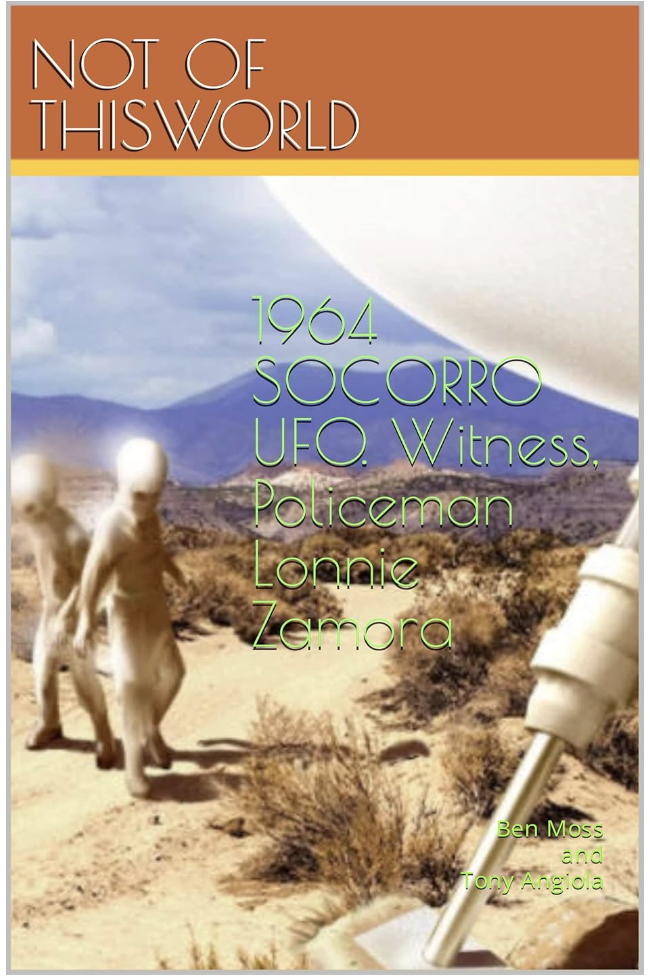
NOT OF THIS WORLD...1964 SOCORRO UFO. Witness, Policeman Lonnie Zamora
By Ben Moss and Tony Angiola
On Amazon: https://www.amazon.com/dp/B08S5JLXRG
The Socorro UFO Incident, The State of Todays Ufology w/ Ben Moss.
https://www.youtube.com/live/-nxlip4R1NE
Unsolved Mysteries - The Socorro UFO
One of the longest running programs in the history of television tells the story of a police officer seeing a UFO and its occupants land in the New Mexico desert in 1964.
https://unsolved.com/gallery/socorro-ufo
About the Author / Host
Daniel Stih is an aerospace engineer, software engineer, indoor environmental consultant, and author of 12 books. For more 30 years, he has investigated complex problems spanning engineering, technology, the built environment, and human decision-making. His work explores how evidence, assumptions, and systems shape the conclusions we draw—and whether we're solving the right problem. Learn more about his approach in Why I Think This Way.