
"Engaging communication has the power to transform the lives you influence”
-Darius Wallace
My guest today is Darius Wallace. Darius is an example of someone who’s turned their creative passion into a career, taking bold steps to live their dream. He’s been in several Hollywood movies, is a founding member of Tennessee Shakespeare in Memphis, and performed as the character Frederick Douglas in thousands of schools, universities, and theaters around the country.
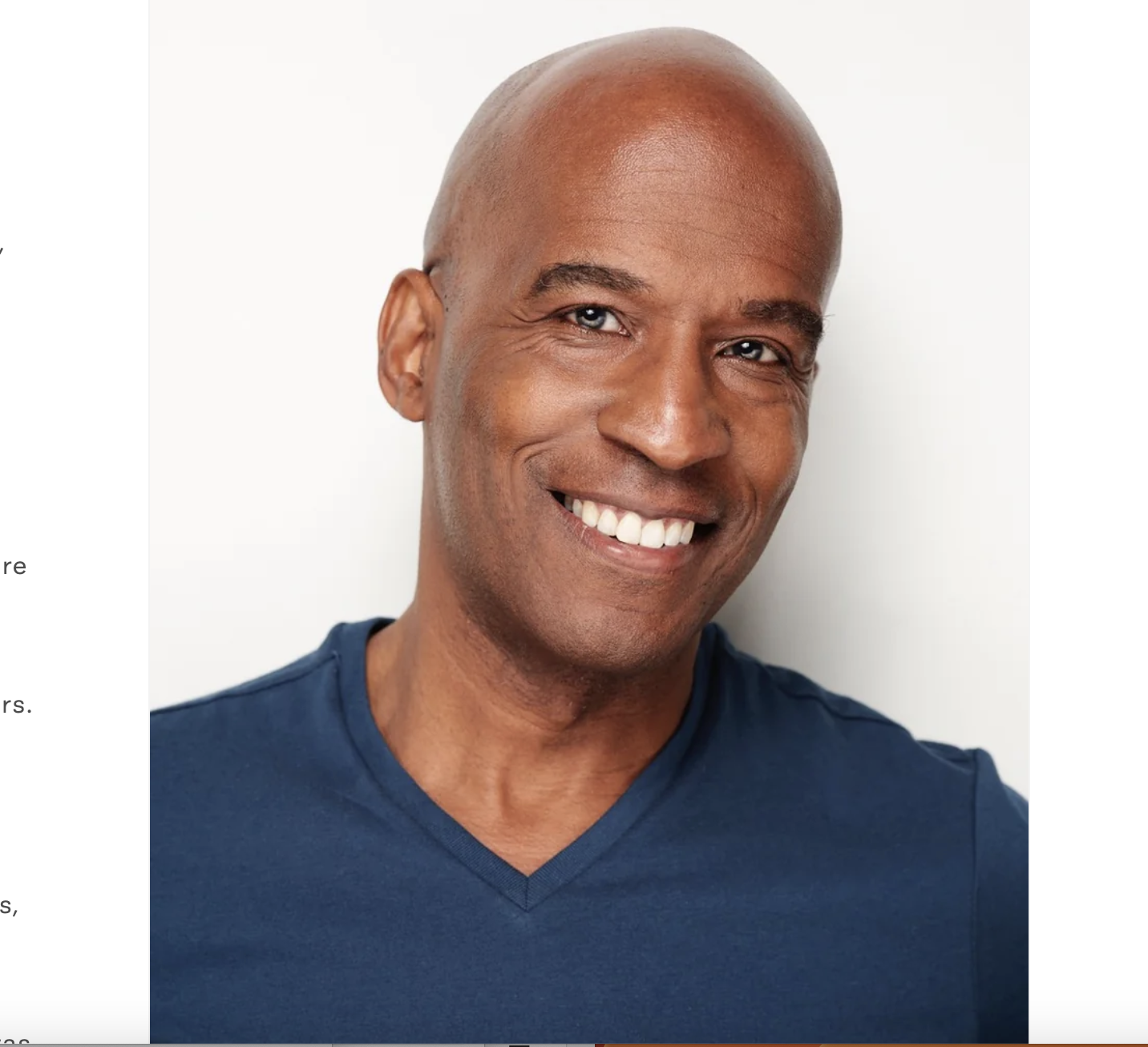
There was a time, however, when Darius was broke and broken. He struggled with anxiety, depression, and thoughts of suicide. Born in Flint, when General Motors was closing and leaving families without jobs, he was thirteen when he joined a street gang. One day there was miraculous intervention. The Vice Principal at his school gave him an alternative — choose your destiny or it may be jail. Darius chose the destiny of his dream. The rest, as they say, is history. He’s been successful following his dream as an actor, speaker, and storyteller, and the TEDx Memphis coach for seven years.
In this conversation we talk about:
- Why it’s important for effective leaders to have good communication skills
- How to “Level Up Your Leadership Abilities Through Communication Skills”
- The “Hollywood” formula for telling a story
- How To Be Engaging On Zoom
- His three step method to overcome a fear of public speaking.
- Why is it important to have an authentic style and deliver your message in alignment with your personality
- The Frederick Douglass Show



About the Host
Daniel Stih (danielstih.com) is an aerospace engineer, software engineer, indoor environmental consultant, and author of 12 books. For more than 30 years, he has investigated complex problems spanning engineering, technology, the built environment, and human decision-making. His work explores how evidence, assumptions, and systems shape the conclusions we draw—and whether we're solving the right problem. Learn more about his approach in Why I Think This Way.
Show Notes
Website: https://dariuswallace.com
Facebook: https://www.facebook.com/profile.php?id=100066601524738
Instagram: https://www.instagram.com/dariusactor/
YouTube: https://www.youtube.com/user/PhilDarius
Transcript
I guest today is Darius Wallace.
Darius is an example of someone who's turned the creative passionate into a career, taking bold steps to live their dream, and building a successful business around that dream.
He's been in several Hollywood movies, is a founding member of Tennessee Shakespeare in Memphis, and has performed as the character Frederick Douglass in thousands of schools, universities, and theaters around the country.
He's confident and successful in doing what he loves to do.
It was a time, however, when Darius was broken broken.
He struggled with anxiety, depression, and thoughts of suicide.
Born in Flint, Michigan, when General Motors was closing and leaving families without jobs, he was only 13 when he joined the street gang, his future didn't look bright.
Then one day, there was a miraculous intervention.
The vice principal at his school gave him an alternative, introduced him to the theater teacher at the school and said, choose your destiny or it would likely be the destiny of jail.
Darius chose the destiny of his dream, and the rest, as they say, is history.
He's been successful following that dream as an actor, speaker, and storyteller since.
He's also the speaking coach for TEDx Memphis now for seven years.
He stays quite busy and I'm grateful for him making the time to do this episode, so we're going to jump right in.
Tell me your story about choosing between, as you say, choosing the destiny of jail or choosing the destiny of following your dream.
Oh, wow.
Yeah, that's a great thing.
Well, you know, there is, I believe that there's the miraculous element in our life, which to me is the uncontrollable.
And what I mean by that is there's, you know, fate, which is things you can't control.
But then there's faith, which is still in a space of not being able to control, but at least there is a sense of hope and a sense of destiny.
And I think that that's repeating in our lives all the time.
That there's some miraculous things that move into place that assists us in moving into the direction that is more beneficial, abundant, prosperous, happy, joyous, and free.
So when you were in a gang, things were looking dark, the factories were closed.
And you're in high school at that point.
And the principal had the insight to go, you know, I got to introduce this kid to the theater teacher.
Were you, in terms of the faith, did you have the faith that something will turn around, something, an opportunity will present itself?
I would have to say yes.
You know, in a sense, this whole journey started not long after coming to Conscious as a child, at maybe about, I don't know, six years old, maybe younger actually, maybe four or five, when my father went to see a movie, and he was so excited about the movie that he came back and brought me back after the movie, and I was punching, and I was kicking, and I was screaming.
I had just seen Bruce Lee's Enter the Dragon, and I wanted to be just like Bruce Lee.
And simultaneously, I was struggling with reading.
And so my father would leave books on my desk, hoping when I would wake up, I would read.
And some of that was Bruce Lee, some of that was great historical figures, Frederick Douglass, Martin Luther King.
And I started practicing martial art, and I continued to grow to the size that I am now.
At 13 years old, I was this size.
I still was struggling with reading.
I still was not the best communicator, but I knew how to communicate with my fists, and I became known for it.
And unfortunately, at that time, Flint was descending because of the collapse of GM.
And so it was the depression in the city during that period of time.
So a lot of negative things began to grow in the city, and gangs was one of them.
And I became a target for numerous reasons, and I did get involved.
But I think that because of wanting to be like Bruce Lee, wanting to be in movies, you know, wanting to be great at martial arts or great at something, that somewhere in the bottom of my soul, that was there.
You knew there was something else.
I knew there was something else, yeah.
Which, you know, there are young people out there that genuinely don't believe that there's something else.
And I was fortunate to have something within myself to let me know there's something else.
You know, the ironic thing, I didn't know your father had to put books out for you to encourage you to read.
The ironic thing is I'm having you on today to talk about communication skills because I think one problem with a lot of people, they struggle in life, they can't communicate well.
And now you teach storytelling to leaders at corporations and you teach people how to public speak.
Yeah.
Yeah.
Yeah.
But you know, what happened at that period of time, I think because I wasn't good at communication, it made me angry.
You know, I couldn't press my emotions effectively.
I couldn't communicate my thoughts effectively.
But I got almost got in trouble with a weapon.
And the vice principal sat me in his office and gave me the, you know, I had to make a choice whether I was going to continue in that life or I was going to get into theater or he was going to tell my father.
And I can tell you right now what I would rather do.
Just send me to jail.
I need to do it now.
Don't tell my father.
And, but I fortunately made a choice to go the route that he was suggesting, which was to go where my passion was.
But I still struggled with communication and I still struggled with expressing myself.
And every time I would get in front of people, I would always forget all my lines.
But then my high school theater teacher, saw something in me I didn't see in myself, and he pulled it out of me.
He found my strength, which is movement.
And so he taught me Panama.
So with Panama, I didn't have to use my voice, but it got me in front of people.
And I knew how to use my body really well because of martial art.
People responded to it.
Then I became comfortable with expressing myself verbally.
And then I learned the world was the beginning of learning about storytelling as a performer.
Well, when you mention Panama, which I probably can't do very well, it reminds me of one of the questions to ask you.
It's on your website, something you teach, which is something people don't really get because they think I've got to do it this way.
Your style, being authentic in how you tell your story.
So tell me why that's important.
You've really done your research.
That's great.
Because my style is simply not your style.
Your style is a different style of communicating than me.
And so what I like to discover or help people to discover is what is your actual authentic style?
What is the way that you naturally communicate?
And how can we then take that and build on that?
Everybody has their own way.
There's no person like me on the planet.
There's no person like you on the planet.
So we have our own way.
We can learn from you.
You can learn from me.
And you can borrow techniques from me and you can borrow what you may admire from me as I can from you.
But at the end of the day, you want to find you in the space.
Because ultimately, people are buying you.
They know if you're faking it.
They won't believe the rest of the message.
Yeah.
And they really want to know you.
And they want to believe in you when you're up there.
And so and then also, too, sometimes I'm working with people and there's a lot of insecurities, which I understand.
So I do what my theology did with me.
I find their strengths.
They may not even be aware of.
And I capitalize on those strengths, which gives them confidence.
And then they start thriving in their communication.
Nice.
Do you have an example of somebody's strength and style other than yours?
Like what's one that comes to mind of a recent?
Yeah, you mean as far as my suit or just a regular like a known public speaker or you talk about?
Just somebody normal, you know.
Yeah.
Okay.
Yeah, sure.
Well, the one more powerful story is there's this young, there was this young man about 27 years old, his mother I had coached.
And she was an introvert too, but I was able to help her and she was in leadership in commercial real estate.
So during COVID, she called me because her son had lost his job, and he wanted to get a new job in his field of technology, but he had the interview.
But he was a massive introvert, massive.
I didn't know at the time.
I figured out it would be no problem.
But the reality was we spent two hours on two sentences, and it was at that moment I thought to myself, I don't know.
I don't know if this is going to work out.
Should I give the money back?
Right, yeah, yeah, yeah, yeah.
And so, but I noticed something in working with him.
His strengths were he's a really good young man, very kind, he also works really hard, he's very diligent, he loves helping people.
Then I recognized I have three students, three types of students.
There are improvisers, people that can go off of the top of their head because they know their subjects so well, outliners, people that can look at bullet points and expound upon them, and memorizers, people that really need to write it out and memorize.
Well, he's a memorizer, I discovered.
And a lot of times when he's communicating, he's pulling off the top of his head and he gets lost, in his self-consciousness and he can't move forward.
He really goes into a cause that I've never experienced in my whole life.
And so when I realized that, we capitalize on that.
We've got mock questions, we wrote out his answers, we memorized it, and we drilled it, drilled it and drilled it and drilled it because he's a hard worker.
And he memorized all of his answers.
These are potential interview questions, like he was preparing for a job interview.
Yeah, yeah, yeah.
And we were doing, I've been integrated my techniques into his memorized content, storytelling and persuasion and argumentative.
You know, all the different things that I teach connecting with the people you're talking to, being authentic to yourself.
He had all of that embedded in what he had memorized.
Well, we did work for a good while.
Six months later, he is getting interviews.
He's getting called back.
He gets hired at like two or three of them.
He chooses the one he wants to work for.
He's still getting hired.
And he's got some long-term skills.
He knows how to do this now.
Yeah.
Yeah.
Yeah.
A year later, he moved into leadership.
A year after that, he won an award.
Nice.
And his style was to memorize, and his shine was his ability to really care about what he was doing and his service to the people he was communicating to.
That was his style.
So, storytelling.
You have on your website an article on Insight.
Oh, I'm sorry, that's some different.
Well, storytelling is on your website in a lot of different places.
It's part of communication.
There's, you teach people different styles of storytelling, and one of them you say is the Hollywood formula.
Yeah.
What's the Hollywood formula?
Give listeners one formula.
So what's the Hollywood formula?
Telling a story.
I'll give you a formula by giving you a story.
Okay.
There was a young man in the 60s who wrote a screenplay that was really, really bad.
And none of the studios wanted to make the movie.
And he was very, very depressed.
But he ran across a book called Hero with a Thousand Faces.
Have you heard of it?
Have you heard of Joseph Campbell?
In that book, there's a concept called The Hero's Journey.
Have you heard of The Hero's Journey?
I read a lot of books.
It's probably, sure I come across it doesn't ring a bell.
Okay.
So The Hero's Journey is a concept that is in all great religions, all great myths, all great folklore.
Oh, yeah, yeah, yeah.
Always.
It's like a good, or there's a quest, and there's a villain, and you're trying to do some good, and there's someone in your way stopping you.
You have to defeat.
Yeah, that's right.
So he reads the book and discovers this concept.
And so he audits a class at Southern University of California, and he takes the knowledge that he gained, he comes back to his screenplay, he rewrites it, and the studios eventually love it.
They love it so much, they turned it into a movie.
In 1978, he's had many, many sequels.
It's now a multi-billion dollar franchise, and it's called Star Wars.
Oh, wow.
That's a pretty big turnaround story.
Yeah.
And the young man is George Lucas.
So the bad script he wrote was on Flash Gordon.
So what was it in the hero's journey that he embedded in Flash Gordon, transformed it into Star Wars, that is now a billion dollar franchise and a religion, by the way.
The forest is a religion now.
It is, okay.
Yeah, it is.
Well, I mean, the world's got energy, so.
Yeah.
And so what is that?
Well, there's a guy by the name of, well.
So the hero's journey though, you're on that formula and I didn't really express it well.
You weigh, there's more to it.
You have Darth Vader, he's the villain.
And the villain's in the way of your cause, right?
Your hero's going on this journey, something's blocking.
What's the formula exactly?
Sure.
Well, the best way that I can express it is has been expressed in a book in movie making called Save the Cat.
And I can't think of the guy's first name, but Snyder is the, the writer, I can't think of his first name.
And so what screenwriters have done and what he's captured are 15 beats for screenwriting and storytelling that captures the hero's journey.
So in the first part of it, there's the ordinary world of the hero, the everyday mundane life, you know, really the boring life.
And in the midst of that, there's an opening where we see, you know, the world that is happening in the ordinary world, the mundane world.
There's some kind of a theme that will be addressed somewhere early on.
There's a set up with all the different characters.
And then there comes a moment of interruption or disruption in the hero's life.
And it's called The Call, where the hero is called out of their ordinary world, right, Dorothy in Kansas, right, into the extraordinary world or the upside down world, which is the Wizard of Oz or the world of the Death Star.
And then in that, but to get to that point, there's normally a debate of, where you're afraid to make a decision.
You don't know whether to do it or not.
To go on the journey.
Yeah, but something propels you, something happens that forces you to make a decision, you know, blue pill, red pill.
And then you finally make that decision, and now you're in this extraordinary world where you need a mentor.
Because you don't know what this world is about, and someone has to train you, because you're about to face the big red dragon, right?
So part of the formula is you need help.
Is part of the formula, a mentor?
We need your seven dwarfs.
Oh, right.
These are allies, right?
And now if you're teaching this to a leader, where you're speaking to a corporation, and you're training leaders on how to communicate, going through the back of my mind now is my seven dwarfs are going to be my employees.
You're actually, you're seven dwarfs as the leader.
It's not really you.
You're the, I train that the leader, that's actually assisting, like the client or the team, you know, the team members or the client that you're connecting with, they're the hero.
I'm sorry about that.
That's how you inspire them and get them on board.
It's their journey.
They're the hero.
Actually, the client is the hero.
The leader that I'm coaching is the mentor.
And what I might also be finding is helping them find their allies.
And the leaders that to help the business find its allies or the client, right?
That they're serving and the false allies, right?
And what the challenge is and to remind the business leader as the mentor, as Obi-Wan reminds Luke, Darth Vader is coming.
That sounds like an interesting, fun job.
It is.
I mean, it's what I love to do.
And when it comes down to-
So my point is, is that's one way, one dimension of looking at it.
The other dimension is why do we tell stories?
You tell stories because nobody makes decisions logically, we make it emotional.
And the quickest way that people's emotions is through storytelling.
Why?
Because when you tell me a story, images come in my mind, I relate it to events in my life.
I have an emotional reaction to it.
Now, you and I are emotionally connected.
You can drive me to the wisest decision based on how I'm feeling, not how I'm thinking.
And so when I'm coaching on that, I first coach on the system of storytelling, then I coach on the why it's important.
But then I give, make it, I shorted it to five P's, right?
And the five P's are purpose, the purpose that you're telling the story, right?
The purpose of me telling you the George Lucas story was that you understand the power of the Hollywood formula, which is based on-
And it also came to mind with him is if he can be not a failure, but have to work at his craft and ask for help and ask for rewrites and ask for a coach.
Yes.
And then look what came from him asking for help and getting a rewrite Star Wars.
That's right.
Then you probably should, whoever is listening probably should.
Yeah, I do.
Yeah, I do.
I have a coach.
I coach, but I have a coach.
I have coaches.
Yeah.
So this person, I mean purpose, then this person who are the characters in the story.
It's important to know who the people are because if you can't name the people in the story, you have no emotional connection to just generalization.
So you want it to be clear.
So the characters in the story, purpose, person, place, where is it happening?
Because environment is everything.
If I'm a young man in France and I'm at the dinner table and I'm wanting to propose and I don't want to lose time, and this is perfect and I got the violin and I'm getting on my knees and I'm making the proposal, will you marry me?
That's one setting.
What if it's in a prison?
Still the young man.
Still have a need to propose.
But there's all these other challenges because it's not a restaurant in France.
It's a prison.
I got to worry about the guards.
I got to worry about timing.
I got to worry about whether or not I'm going to be able to propose quickly before they remove me.
So purpose, person, place, problem.
What's the conflict?
That's the strongest and biggest part of the story.
The story without conflict is like a car without an engine and ain't going nowhere.
It's kind of boring.
It doesn't hold your attention.
That's right.
And so you want to make the conflict, the challenge strong.
You want your nemesis, your antagonist to be impossible to beat.
It's like, why are we going to war?
If there's no real, if the enemy really doesn't have a chance or there's no contest.
You know, it's interesting about that because I'm a fight fan.
I love boxing and some of the greatest, most memorable fights were between two.
The beautiful thing about the movie Rocky is Apollo Creed is an impossible opponent to beat.
And in boxing, if that impossibility is not there, Ali and Foreman, Ali and Liston, right?
Then Ali and Frazier, that greatness doesn't really happen, no matter how great the boxer is.
There are other boxers that are phenomenal.
They're so phenomenal that some of the best fighters are in for them to beat.
They're great.
Yeah, it would be like Star Wars.
If the rebels had billions of fighter airplanes, they could just take out the Death Star without any kind of challenge.
You'd be like, well, what's the story?
What's the story?
Yeah, what is the, you know, what's driving us forward?
Because we all are dealing as human beings with challenges that are too big for us to handle.
And we need to believe that we can overcome those challenges.
But we need stories that can relate to us, right?
As human beings.
So problem, conflict is really important.
I'm starting to get why as a leader, if I was trying to lead people, I would go this route, this storytelling route.
It really engages them emotionally and like, where are we going?
What's the challenge?
Yeah, here's how we're going to do it.
So if somebody is on to switch gears for a little bit, if someone is afraid of public speaking, you have a three-step method.
What's the first step?
Like what's one step?
The first step to get over a fear of public speaking.
So you can even tell your story.
Yeah.
Well, the first step, well, let me just say, I work out of four concepts, ethos, pathos, logos, and telos.
These are from out of Aristotle.
They're also thousands of years old.
They also are in every great religion, every great folk, great book, every great movie.
Ethos is ethics.
What is that?
That you're speaking on something you have experience and expertise in.
So, the first step is to...
A lot of times there's imposter syndrome.
Because we've forgotten who we are.
We've forgotten our experience.
Imposter syndrome, listeners, basically means you are good.
You deserve to be the speaker.
You just don't realize.
You're just not...
You're too humble.
Or you've forgotten.
You've forgotten all the experiences you've acquired over the time.
You've forgotten all the expertise, the knowledge that you have, that people need.
They need your experiences.
They need your expertise.
You don't mean literally forgetting.
You just mean you're not consciously remembering, oh, this is why I'm the best person to lead this or tell this story.
Yeah.
Which to me, I like to use the word forget, because it's a little bit of stronger word, because when they remember, when they remember who they are, when they remember, right now, forgetting in the sense of they're dismembered.
Well, to give you an example of my own, I'm an aerospace engineer, so I have a project class where I've got to write a paper and then it's a speaking, it's a communication class actually.
And as an engineer, we don't give very many communication classes.
Okay.
And we're supposed to pick something to present that, so I'm picking on presenting as if I'm the leader at Lockheed Martin, on we're building the next biggest fighter airplane, the F-16 or whatever it is, and comparing it to the F-14, whatever.
I've tanked hard.
Why?
I don't care.
I don't care about fighter planes.
I might like going to space.
I might like SpaceX.
So no matter how much I studied and tried to research these airplanes to prepare the speech, which I thought was technically good, it did not work at all because I didn't really know it.
It wasn't my thing.
Why didn't you choose your thing?
That's a good question.
Yeah, we like pick space, pick rocket ship space, something else like that.
You know, it could have been, I honestly don't recall, but it could have been, I didn't realize I could speak about anything, go outside the box, get creative.
You're in school, so you're trying to pass the class.
Well, let's do this.
Let's just deal with what you actually spoke on.
But you did choose that for a reason.
Is there something intriguing about?
Oh, maybe I thought it would excite the audience.
Like, look, we're talking fighter airplanes now.
Isn't that cool?
But is that cool for you though?
No, that's the thing.
I thought it would be interesting for other people.
I wasn't knowledgeable about it.
Oh, okay.
This is going back to your point, which is B, you have imposter syndrome.
I was an imposter.
I was not an expert on fighter airplanes.
Yeah.
Well, let me just say, just to make sure that I'm, because I'm now I want to help you.
So here's the thing, ethos, ethics.
So when you're standing in front of people, part of what builds that line of trust is being ethical.
And being ethical means you have experience or expertise in what you're speaking on.
It doesn't mean that you have to know all, like I do one-man show on Frederick Douglass.
I do not know everything about Frederick Douglass.
But what I do know of is what I perform and what I can, you know, as a question that I'm constantly learning.
So the first thing with you is you want to trust yourself in your own passion, to speak on the things you actually have experience and expertise in or that you know more about that you really are passionate about because the next layer of that is resonance.
That you speak on what you resonate with, that you're not speaking on what you think people want to hear.
You're speaking what you believe in that you're not afraid to say what you believe.
The worst thing that could happen to you as a speaker is everybody loves you.
That means you're generic as hell.
Okay, I'm just getting that now.
It's backwards from what you would think.
If everybody loves you, you're saying it's too vanilla, you didn't really do anything special.
Well, here's the thing is conflict is good.
Batteries and things don't operate without a negative and positive charge.
That creates the electricity, the energy, the discourse that moves things forward.
Edge to it, some edge.
Yeah.
And so you want to resonate with what you're saying and the way you find your resonance, you find your resonance when you discover what's your inspiration, what's your passion, what do you believe in, what are you willing to stand on, and in fact, what are you willing to die for?
That you believe that strongly about it because that's what's going to drive you in your experience and expertise and help you to believe in what you're talking about.
And then the bottom of it is where everybody struggles, which is ethosis, intrapersonal communication, which is how are you communicating to yourself?
What stories are you saying to yourself about yourself?
What stories were you telling yourself about what you were speaking and about how you were coming across?
Because if it was in the negative, well, that's what showed up.
And so if you learn to affirm who you are and to speak positively about yourself and then to have the ability to take care of yourself, that you take care of your mind.
You're watching what goes into your mind because your thoughts are creative.
What you're hearing, what you're tasting, what you're speaking, how you're taking care of your body, your soul, your spirit, all these things are important when it comes down to communication.
Because when you get on that stage, that's who's showing up.
Listen, there's a story about a man who had a dream about two wolves.
One was a good wolf and one was a bad wolf.
And the father woke up afraid and he told his son about it.
And his son said, well, dad, if the two wolves fight, which one is going to win?
And the dad said, the one I feed the most.
See?
The one I see?
The one I feed the most.
I will feed the one I feed.
That's the one is going to show up.
So what wolf are you feeding within yourself?
And you want that to be the good wolf.
All I mean by that is, is you want to be affirming.
You got enough negativity in the world.
Affirm who you are.
Affirm what you're doing.
And affirm what you're about in your uniqueness and your beauty and your power and your inspiration.
Here's why, because number two, to overcome the fear of public speaking is once you're on the stage, it's no longer about you.
It's about the audience.
And a lot of times we're afraid to get up in front of people because we're so focused on what will people think about me.
You don't care about what I'm saying, and what I'm doing, and how I'm looking.
I, I, me, my.
You're going to drive yourself nuts if you stay in a space of constantly wondering and worrying about, and super self-conscious about what people are thinking of you.
And you get on stage and it's hard to even move.
That's what would happen to me every time I would get in front of people, I forget all my lines, because I was so self-conscious on what people would think of me.
But if I can remember my experience and my expertise, and that these people are here because they need it, and if I can begin to focus on them, it's going to alleviate a lot of that fear because now it comes, becomes about the audience.
So basically remember why you are speaking.
That's right.
As a musician, when I get that, I get in my head and I'm like screwing up.
Daniel, come back.
Where did you go?
I'm like, just remember it's to forget about all what you were saying about me and how I look, and I'm trying to get back into why am I here?
Why am I here?
To set the vibe with the music.
That's right.
Then lastly, it's the actual techniques themselves.
For people, when it comes on to public speaking, it's one of the greatest fears.
People fear it over death, which means they would rather be in the casket than giving the eulogy.
And so for some people, when you say, hey, I want you to do this speech, what they're hearing is, hey, I want you to go fly this airplane.
Yeah, go to the firing squad line or go to war, go to, yeah, take a bullet.
Yeah.
You don't know how to swim.
It's all right.
Just jump in and you'll figure it out.
So people are terrified, but guess what?
Even if you're terrified of flying a plane or swimming, getting in water, once you understand it and you learn different techniques to anchor yourself in before you know it, that takes away the fear.
And then when you do those techniques again and again and again and again, it just decreases more and more and more and more.
So what techniques are you learning?
There's several, but the first and major one is, is always know what is it that you want the audience to walk away with when they leave your presence?
Which will help a lot because when I've done some public speaking, I've had bad facilitators.
You know, I'm supposed to have a half hour.
And they haven't booted the previous speaker off the stage.
It's like 15 minutes until now.
I've got 15 minutes left.
And I'm like, Daniel, you can stick to your prepared speech or you can think, what do I want the audience to take away?
And just forget about the script, jump into that.
Yeah.
Because let me tell you what it does.
When you anchor yourself in the techniques and skill sets, when you're on stage, you're committed to the techniques and the skill sets.
You're committed to getting to the goal of making sure the audience walks away with value.
That also helps you forget, right?
Because you're focused, you're really working on the craft.
I guess that was a deer in the headlights thinking, okay, I got 15 minutes because I'm going to get off on time.
And I want people to know this.
You just said my whole worrying about everything else and what people think went out the window, because I was laser focused on, I want you to know this before I get off the stage.
Yeah, that's right.
That's right.
And then it's just the repetition, the repetition of the process that can decrease that fear.
So that's what I, and then we, and it's a constant working on retelling, you just, how you communicate to yourself, the stories you tell yourself.
Well, let me ask you, tell you my experience afterwards, because I would imagine it happens to you a bit with your show you do.
You could do a great performance, and people clap, maybe they do, maybe they don't.
Sometimes they don't because it's not appropriate.
Maybe it's dinner time and-
Yeah, I have that happen.
It's a black tie event, it's formal or whatever, and you go, I don't know if people liked it.
Did they get the message?
Tell me your experience with that because back to being a musician, quite often, same thing, you're doing it for dinner in a restaurant, people aren't clapping, you don't want them to.
You don't know if they liked it and really touched them.
Where I'm going with this, Darius, is tell listeners if they don't get the immediate feedback that doesn't mean they were not great.
It's true.
And more so even than that, if you do the work and you do your best to do to reach that goal, once you've done that, you're done.
And whether they get it or not, well, the hope is they did.
But at the end of the day, you're finished.
But what you will more than likely find is that if you're committed to what you're doing, people were touched, they were moved.
They may not have laughed at your jokes.
You know, in theater in particular, you know, you may get with an audience.
And it's silenced most of the time.
We come back to the stage and we're like, man, I don't think they liked it.
They didn't respond to anything.
But then there are people in the lobby waiting for you and they're like, we were so moved.
You guys were so great, right?
Yeah.
And then, you know, it's the same with, I had my first moment where there really wasn't any clapping as a performer and it felt weird.
But it was, it was intense because it was, they invited me as Frederick Douglass to speak for an event on Constitution Day in Maryland.
Well, Frederick Douglass' speech along with his Fourth of July speech, which I mixed, is more of a holding America accountable to that promise.
And this was a conservative audience.
And it was not what they were expecting.
But it was Frederick Douglass.
That was his speech, that's what he would say.
So at first, when they didn't clap, I was like, well, I think I just offended 200 people.
But after, there was so many people that came up and they were so moved.
It wasn't, listen, it's not about the hand claps.
Some people do it out of courtesy anyway.
It's not about the standing O's.
Some people do that because they're just being courteous.
It's not about the laughs.
Sometimes they could be laughing at you and not with you.
Right?
It's not about you.
It's not about me.
It's about them.
And when you give them the ball, when you give them the wisdom, when you give them the pearl, right?
At that moment, it's up to them.
You know, it's up to them.
They have choice.
Yeah, it's up to them.
Jesus said, do not cast your pearls before swine.
Yet, at the same time, Jesus was casting pearls before who we would call swine, which is kind of weird to me.
I would say, cast your pearls to whoever's there, because you never know what transformations you're going to make.
And if they throw it away, well, it's okay.
Why?
Because we're a wealth of knowledge, a wealth of information.
It's all right.
So, Darius, one last thing.
Real quick, you have something on your website, how to be engaging on Zoom.
And a lot of us use Zoom for meeting.
What's one or two things people can do on Zoom to be more engaging and do what we're speaking of, communicate, get their message across better?
Sure.
I think one main thing is probably the main thing.
I mean, of course, there's all the technical elements, good lighting, good sound, making sure, I would say right now, because I'm on my phone, but you're more perfect than I am.
I'm probably better now and then also finding the camera, because now it looks like I'm looking at you and your eyes.
That's always a tricky one, looking into the camera, especially if you're looking at your notes.
Yeah, right, right.
Yeah, that's right.
That's right.
Well, sometimes the way that is set up on the screen, it helps give the illusion that you're still looking into the camera.
But the biggest thing is, if you notice, my energy level is high.
The reason why is because when you're on Zoom, you must be even more energetic, because the camera is always on you.
It never leaves you.
And so if you don't have energy in your body, there's not an enthusiasm and you don't have a melodious voice, then on Zoom, it comes across as dry.
Right now, I have a very resonant, just resonant voice, right?
So if I treat it like it's a movie, and I'm speaking how I'm speaking right now, I'm very monotone.
And because of my voice and being very monotone, this really eventually can hypnotize you.
Yeah, I'll go to sleep.
Yeah, probably.
So how do you get more energized?
Yeah, you want to get, you want to, you want to, right now there's no back to my chair.
Sometimes it's good to be able to sit on the edge of your seat.
Sometimes it's good to be standing.
But the key is that you want to, you want to invest more of yourself into the camera, then less when you're on Zoom.
Standing is a good one.
I remember when, back before Zoom, when I would do radio interviews and it was on a landline, it was key.
I stood.
No one could see me.
I'm just on the phone.
It helped a lot just to stand.
Yes.
You want that energy to be there when you're on Zoom.
So all your stuff will be in the show notes, your website and where people can go for your workshops and to hire you as a speaker or a coach.
Is there anything else you want to add?
No, that's it.
Yeah, I'm also an actor.
I do one person show on The Life of Frederick Douglass in theaters, universities, schools and colleges.
Also my website.
So I love to tell that story too.
Do you have time?
Do you want to tell about your show real quick?
The Frederick Douglass Show?
Yeah, sure.
I've been doing Frederick Douglass for over 20 years now.
Started off as a show for children, in middle, elementary and middle school.
And it grew into high schools and colleges.
Eventually it played off Broadway back in 2013.
And then it got to more universities and theaters, and it's had many, many different transformations and versions.
But the latest version is the one I'm the most proud of, and it's called Frederick Douglass, The Lion of Freedom.
And in this show is actually I come out as myself, the actor.
And I integrate my story, some of which you've heard, and how it connects to Frederick Douglass' story.
And the audience watches me transform into Frederick Douglass throughout the show.
I have not heard of Frederick Douglass.
What's that story?
Frederick Douglass was a great abolitionist in the 1800s.
He was born into slavery.
And at seven years old, he knew that something was wrong, that he was not supposed to be a slave.
And he began to teach himself to read, which was against the law for slaves to read.
But he taught himself to read anyway, and he was thrown into jail for it.
Can you imagine that?
There was a jail.
Which is kind of like your backstory.
You said your father left books out for you because you were just not into reading either.
Yeah.
Yeah.
And so he began to read, and he was thrown in jail for it, which the irony of that, there's a jail on a slave plantation.
And he was thrown into jail because he was teaching other slaves to read.
And eventually, after being beaten daily by Covey, which was the overseer of a plantation at Mount Misery, he fought back and he beat Covey and he beat the other overseers.
And the only reason why he wasn't hung was because Covey didn't want the word to get out.
He didn't expect that Frederick Douglass had beat him because he would lose his career.
He was known to be the slave breaker.
So he sent Frederick Douglass into the city, Baltimore, to help build ships.
And Frederick Douglass learned this skill and he began to realize people respected him because of his talent.
Build ships?
Yeah, he would cop ships, basically.
He was a copter.
Oh, ships for the water?
For the water, yeah.
It's the Eastern Shore, so water and ships.
Build shipbuilders, yeah.
Yeah.
So he did that.
And so he became a tradesman.
But of course, whenever slaves were sent out into the cities to work, they'd have to bring the money back to the plantation and give it to the slave owner.
So Frederick Douglass, one day, he met a woman who was free, free black woman.
They courted it, fell in love, and she conspired to help him set himself free.
And he did.
He ended up leaving the plantation.
He impersonated a sailor and took a boat into a ship, into a ship, into a train and ended up in New York.
And then he went further and ended up in New Bedford.
And he begins then to start his life over and became a public speaker and an abolitionist.
And he was so grand and so powerful, he became a star.
The best way to put it, he was the Jimi Hendrix of the 1800s, basically.
Couldn't get in to see him.
Everywhere he spoke, there was lines outside the door.
And he became very controversial because he was advocating for the ending of slavery.
And he became an advisor to Abraham Lincoln during the Civil War.
He started his own newspaper.
He became, he started his own bank.
He became the ambassador of the United States to Haiti and the Dominican Republic.
And then toward the end of his life, he began to fight for women's rights.
So this is just a touch of his life.
It all started with him fighting back.
Well, actually, it all started with him learning the power of the written and spoken word.
Oh, he was learning, he was teaching himself how to read.
Yeah, yeah, that's where it started.
That's where he got into trouble.
It all started or that's where his life took a destiny, a turn for his destiny, teaching himself to read.
That's right.
That's right.
Reading is powerful because letters are symbols.
And when they become words, they're ideas.
And when we put those words, those ideas in our head, we create images of sort of a movie in our own head.
And that movie manifests.
To ask you to, or I was trying in my own head, trying to reframe it.
It's not just, oh, I need to read.
It's bigger than that.
It's about what is reading doing?
It's inspiring me to think, giving me ideas.
Yeah.
It puts a spell on you.
That's the reason why we call, that's why we call spelling words.
It started when he thought there was more than life on the plantation.
That's right.
There was more.
And whatever our plantations are in life, you know, whether they're drugs, alcohol, any addictions, any kind of sexual abuse, domestic abuse, abuse on the job, wherever we are gang life, all of those spaces and places are elements and versions of slavery.
But a good way to put it.
Yeah.
When we can see ourselves, our future selves outside of those environments in our future life, then we literally can head toward that life and that life will manifest for us.
Which just takes one thing, one step.
Yes.
Doing one thing different or moving one step forward, taking some action no matter how small.
Yes, that's right.
Yeah.
Yeah.
So that's what the show is about.
Nice.
I get it now.
Plus you just gave me a history lesson and I should know this stuff.
All right.
Yes.
How we learn.
One of my guests on a previous show was League of Women's Voters.
Oh, wow.
Okay.
Amazing.
Yeah.
A lot of respect for them.
And I understood they don't just have women members, and they started back when women couldn't vote.
Yes.
Yeah, those was founded.
And now it's just about how to make the voting system better, and our men that are members.
It's a good cause too.
So thanks, Darius.
I really appreciate you.
Thank you.
I appreciate you.
Yeah, it was fun.
A lot of fun.
Thanks.
And I'll send you, I'll put everything again in the show notes about what you do, and good luck with your shows.
Thanks, Daniel.
I really appreciate it.
Also, a reminder to people, he really is a coach.
If you're trying to learn how to public speak or you're a leader in an organization, and you just want to learn how to communicate better so that people follow you, get your message, go where you want to go, do what you want to do.
Thank you, Daniel.
I appreciate this.
I'm excited to re-listen to the show.
All right.
You be well.
You too.
Thank you.