

- Host: Daniel Stih (Board-Certified ACAC Environmental Consultant [CIEC/CMC], Aerospace Engineer, Senior iOS Developer, Zion First-Ascent Mountaineer, Singer-Songwriter [Daniel Isle Sky], and Founder of danielstih.com)
- Featured Guest: Kathy McDaniel (Bestselling Author, NDE Researcher, and Director of Distressing Near-Death Sharing Groups for IANDS)
- Core Concept: Applying Wave-Based Signal Processing and Non-Local Memory Storage Models to evaluate how consciousness operates when neurological systems are clinically offline.
- Topics Analyzed: Near-Death Experiences (NDEs), Acute Respiratory Distress Syndrome (ARDS)Pathophysics, Coma Memory Storage, and Non-Local Consciousness Architecture.
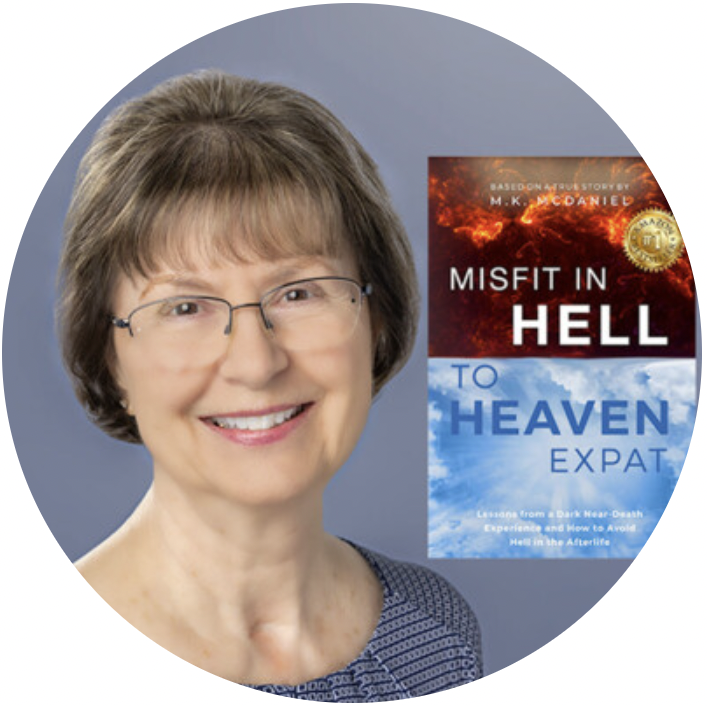
My guest is Near Death Experiencer (NDE) and best-selling author Kathy McDaniel.



Near-Death Experiences: What Happens When Your View of Life Changes Forever
A conversation with Kathy McDaniel
Near-death experiences often raise questions about consciousness, death, and what may lie beyond life. But beneath those questions is another, perhaps more universal one: How do people make sense of experiences that fundamentally change the way they see the world?
In this conversation, author Kathy McDaniel reflects on her distressing near-death experience, how it challenged decades of religious beliefs, and why she ultimately came away with a message centered less on fear and more on compassion.
When an Experience Challenges Everything You Believe
Before describing her experience, Kathy makes an important clarification. Although she had been placed into a medically induced coma during a life-threatening illness, she was not clinically dead. That distinction becomes important because it shifts the conversation away from definitions and toward a broader question: what exactly constitutes a near-death experience?
Rather than immediately debating conclusions, the discussion begins by defining terms—a pattern that appears throughout the interview. Kathy explains that many researchers use "near-death experience" to describe situations in which consciousness appears to continue while a person is close to death or otherwise separated from ordinary awareness.
What makes Kathy's story unusual is not simply the experience itself, rather it's the fact that it contradicted what she expected to happen based on a lifetime of religious beliefs.
"As long as your soul has left the body and gone to another dimension, you're considered a near-death experience."
A Distressing Near-Death Experience
Popular accounts of near-death experiences often describe overwhelming peace, light, and feelings of unconditional love. Kathy's story begins differently.
She describes awakening in darkness before entering a series of frightening environments she interpreted as hell. Years later, after speaking with hundreds of others through the International Association for Near-Death Studies (IANDS), she concluded that these experiences may be more common than many people realize, even if they are discussed far less often.
Perhaps the most thought-provoking part of her interpretation is that she no longer believes those frightening scenes represented an external punishment. Instead, she came to view them as manifestations of deeply ingrained beliefs and fears she had carried throughout her life.
"About 20% of near-death experiences have some sort of distressing or hellish flavor to them."
Community Helped Her Make Sense of the Experience
For nearly ten years Kathy told almost no one what she had experienced. She struggled to reconcile her memories with both her religious upbringing and conventional medical explanations. It wasn't until she discovered IANDS that she found a community where distressing near-death experiences could be discussed openly.
Rather than focusing only on extraordinary stories, the conversation highlights something practical: the importance of finding a place where difficult experiences can be explored without immediate judgment.
Today Kathy helps facilitate support groups for others who have undergone similar experiences—many of whom spent years believing they were alone.
"I carried that around a long time trying to figure out what the hell happened."
The Message She Brought Back
Although Kathy's experience began with fear, she says the lasting message had nothing to do with punishment.
When asked what she ultimately learned, her answer became remarkably simple: be loving and kind.
Rather than describing complicated spiritual rules or theological doctrines, she explains that this principle became the foundation of how she now approaches daily life. Whether interacting with strangers, volunteering, or supporting people facing grief, she believes small acts of compassion have a ripple effect that extends far beyond the moment.
The discussion naturally expands beyond religion and into human behavior. Many opportunities to improve someone else's day require nothing more than saying hello, offering help, or showing kindness to someone who appears alone.
"If you can't remember all of that... just be loving and kind."
Bigger Questions About Consciousness
The interview eventually shifts away from Kathy's personal story and toward broader questions about consciousness and memory.
One question particularly captures my engineering perspective: if people report detailed memories from periods when normal memory formation is believed to be impaired, where are those memories stored?
In the closing discussion, I introduce a thought experiment comparing memory to cloud storage rather than a computer hard drive. Rather than claiming this as an explanation, I present it as a possible model that might help people think differently about non-local theories of memory and consciousness.
Why This Conversation Matters
This conversation is about more than near-death experiences.
It's about what happens when an experience no longer fits the framework you've used to understand the world.
Whether someone agrees with Kathy's interpretations or not, her story raises broader questions about belief, consciousness, memory, and how people reconstruct meaning after life-changing events.
Perhaps the most enduring takeaway isn't a claim about what happens after death, but a challenge about how we live now. If there is one lesson Kathy hopes listeners remember, it is surprisingly simple:
Be loving. Be kind.
Further Reading & Resources
Kathy's website: http://www.misfitinhelltoheavenexpat.com
Her book: Misfit in Hell to Heaven Expat: Lessons from a Dark Near-Death Experience and How to Avoid Hell in the Afterlife
https://www.amazon.com/Misfit-Hell-Heaven-Expat-Near-Death/dp/1952146089
The International Association for Near-Death Studies (IANDS)
As an educational nonprofit organization which focuses resources into providing the highest quality information available about NDE-related subjects. It is the only such membership group in the world. Anyone experiencing an NDE should know about this organization: https://iands.org/
Connect with Kathy McDaniel:
Facebook :https://www.facebook.com/KathyMcDaniel.FoxIs
Twitter: https://twitter.com/MKMcDaniel3
YouTube: https://youtu.be/8WsiriExZOI
Instagram: https://www.instagram.com/kathymcdaniel.foxis