
Recovery Questions for Clarity, Insight, and Better Decisions
Most confusion isn’t caused by low intelligence — it’s caused by compressed language.
People think they disagree about ideas, when they’re reacting to unexamined assumptions embedded in words. Language regularly deletes, distorts, and generalizes information. The result is statements that sound precise — and fall apart when examined closely.
In this essay, I show a practical method I use to think clearly: Recovery Questions — simple follow-ups that “recover” missing meaning and turn vague claims into testable statements. The approach is inspired by the Meta Model from NLP. The use case is plain and practical. It helps you uncover what’s really being said, before you argue, commit, or act.
You’ll see how this works through examples and a set of common patterns that routinely create confusion — along with the questions that clarify them.
If you want better decisions, better conversations, and fewer costly misunderstandings, start with the words.
Think of it as X-ray vision for language
Why Language Hides More Than It Reveals
What someone says—or what you read—is often not what they actually mean.
Language compresses experience. In doing so, it:
- Deletes information
- Distorts relationships
- Generalizes specific cases into “truths”
The result is sentences that feel authoritative but collapse under examination.
The solution isn’t arguing.
It’s unpacking.
Example 1: “The Only Way to Be Successful Is to Wake Up at 5 a.m.”
At first glance, this sounds motivational. Let’s slow it down and examine the words.
“Only”
- Is this truly the only path?
- Are there no counterexamples?
- Who benefits from framing success this way?
“Way”
- Does this imply a single, fixed path?
- Or just one possible method?
“Successful”
- Successful at what, exactly?
- Career? Parenting? Health? Happiness?
- Who defined success in this context?
“Wake up at 5 a.m.”
- Why this specific time?
- Is the claim about discipline, quiet hours, or imitation?
- Is it universal across professions, cultures, sleep types, or time zones?
Once examined, the statement no longer feels like truth—it feels like a belief, often inherited, repeated, and rarely questioned.
That shift alone creates clarity.
Example 2: A Real-World Claim From Mold Remediation
“The only way to kill mold is to treat it with a sanitizer.”
This sentence is packed with assumptions.
“Only”
No alternative? Ever?
“Kill”
- What does “kill” mean here?
- Is dead mold harmless?
- How is “dead” verified?
“Harmless”
- According to whom?
- Under what conditions?
“Treat”
- What does treatment involve?
- Surface wiping or deep remediation?
“Sanitizer”
- Which chemical?
- Approved by whom?
- Effective against which organisms?
-
At what depth?
A Better Question
Instead of arguing, reconstruct the claim:
“Is what you’re saying that the only way to completely eliminate the mold, both on surfaces and inside the wood framing, is to apply a product that removes 100% of it?”
Now the conversation is about outcomes, instead of marketing language.
The Core Technique: Recovery Questions
Rather than debating conclusions, ask questions that recover missing information.
A simple starting point is:
“Is what you’re saying that…?”
This keeps the conversation collaborative, not confrontational.
Common Language Patterns That Distort Meaning
(And the Questions That Fix Them)
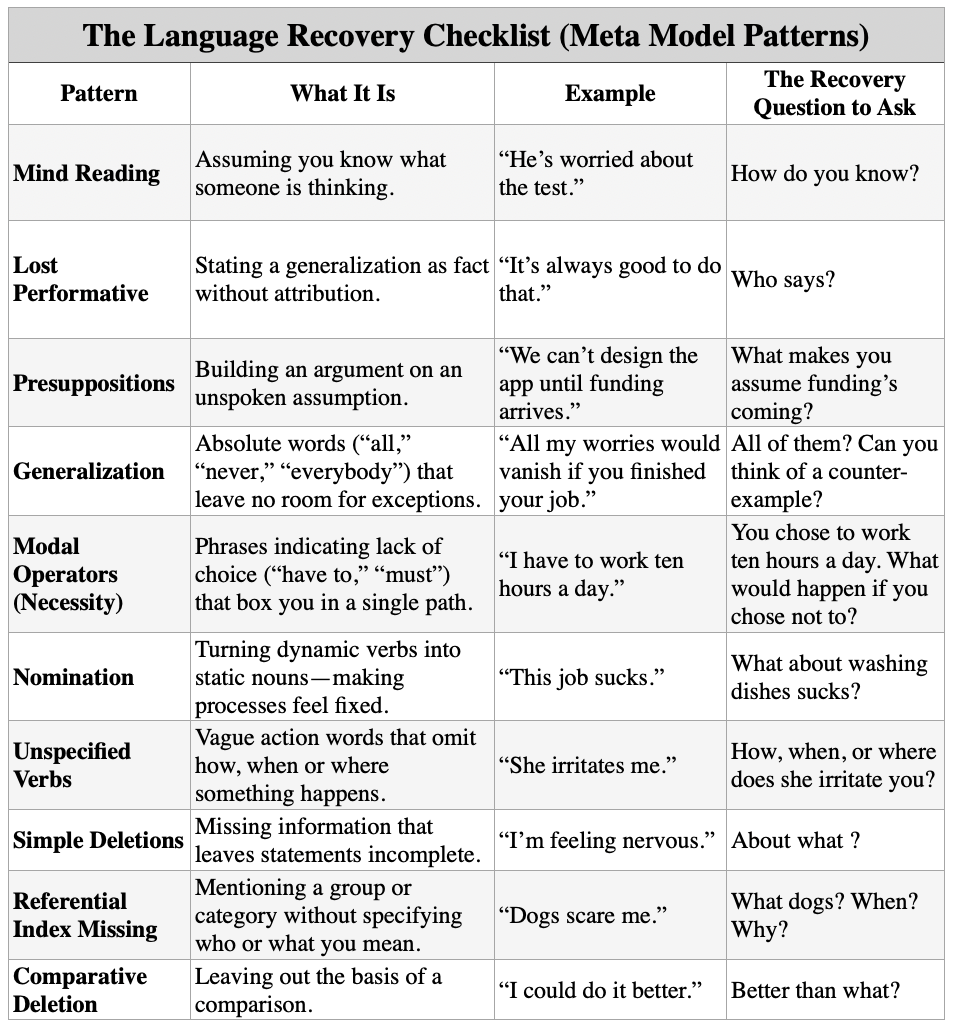
1. Mind Reading
Statement: “He’s worried about the test.”
Question: How do you know?
2. Lost Performative
Statement: “It’s always good to do that.”
Question: Says who?
3. Presuppositions
Statement: “We can’t design the app until the funding arrives.”
Question: What makes you assume it’s coming?
4. Generalizations
Statement: “All my worries would disappear if you finished your job.”
Question: Can you think of a worry that would remain?
5. Modal Operators of Necessity
Statement: “I have to work 10 hours a day.”
Question: What would happen if you chose not to?
6. Nominalizations
Statement: “This job stinks.”
Question: What specifically about it stinks?
7. Unspecified Verbs
Statement: “She irritates me.”
Question: How, when, or where?
8. Simple Deletions
Statement: “I’m feeling nervous.”
Question: About what?
9. Missing Referential Index
Statement: “Dogs scare me.”
Question: Which dogs? When? Why?
10. Comparative Deletions
Statement: “I could do it better.”
Question: Better than who or what?
Why This Matters More Than Ever
We live in an age of:
- AI-generated content
- Repeated summaries of summaries
- Statements stripped of context
A significant portion of what circulates today is technically composed but conceptually unclear. Clear thinking depends on clear language. AI tools won’t automatically challenge vague statements unless you instruct them to. Humans rarely do it either.
That’s why this skill matters.
How I Use This Method
- When writing books, to remove ambiguity
- When reading articles, to detect hidden assumptions
- When responding to difficult emails
- When navigating business decisions
- When clarifying emotional conversations
It’s not about winning arguments.
It’s about understanding reality accurately.
Final Thought
Most confusion disappears when you stop reacting to sentences and start examining words.
Slow down.
Break it apart.
Ask better questions.
Clarity lives underneath the language.